
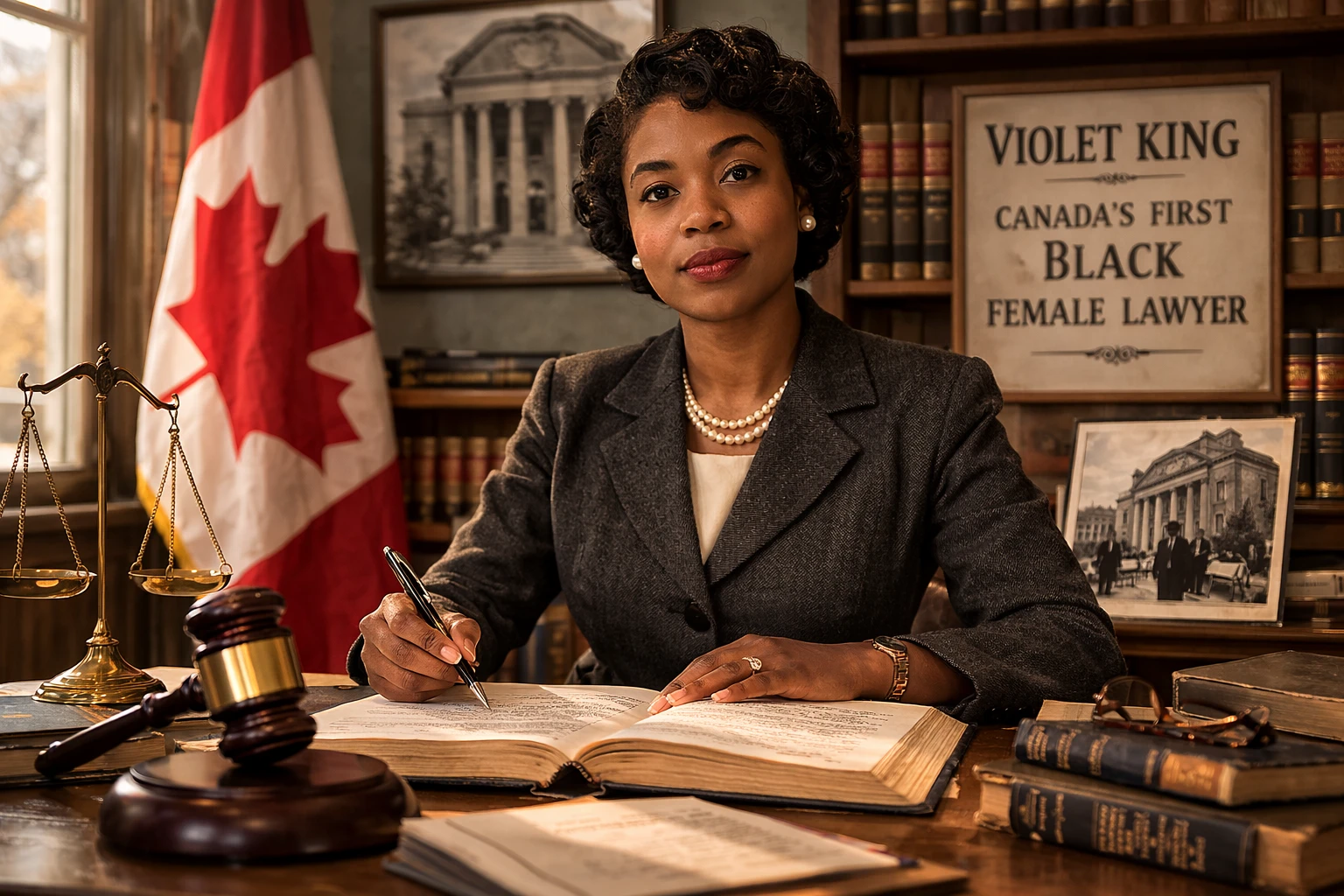
A Legend You Should Know: The Story of Violet King
Have you ever stopped to think about who broke the glass ceilings in Canada before it was even a “thing”? We often hear about international icons, but right here in our own backyard, we had people like Violet King. Honestly, if you haven’t heard her name lately, that’s a bit of a shame because her life was basically a masterclass in grit. She wasn’t just a lawyer; she was the first Black woman to be called to the bar in Canada. That happened in 1954, a time when the legal profession looked nothing like it does today.
Imagine walking into a courtroom in Alberta in the fifties. You’re young, you’re Black, and you’re a woman. The odds weren’t just stacked against her; the deck was practically glued shut. But Violet didn’t really care about the odds. She had this drive that’s hard to find these days. She grew up in Calgary, went to the University of Alberta, and just kept pushing until she made history. It’s one of those stories that makes you feel a bit small but also incredibly inspired.
What’s wild is that she didn’t just stop at being first. She used her platform to talk about racism and labor rights long before these were mainstream topics in corporate Canada. She was a powerhouse in every sense of the word. And yet, for a long time, her story was tucked away in history books that most people didn’t bother to open. Let’s change that, shall we? Because understanding where we are now as a country means looking back at the people who actually cleared the path.
The Calgary Roots and the Early Hustle
Violet King was born in 1929 in Calgary. Back then, Calgary was a much smaller, tougher place. Her parents had moved from the United States, seeking a better life, which is a classic Canadian immigrant story. They settled in the Hillhurst neighborhood. Growing up, Violet was already showing signs that she wasn’t going to follow the “traditional” path laid out for women at the time.
In her high school yearbook, she literally wrote that her goal was to be a criminal lawyer. Most kids write things like “doctor” or “traveler,” but she was specific. She knew exactly what she wanted. And she went for it. She enrolled at the University of Alberta in 1948. Can you imagine being one of the only Black students on campus? It couldn’t have been easy, but she was involved in everything. She was in the blue-and-gold society, she was an executive in the student union-she was basically the person everyone knew.
Her time at university wasn’t just about hitting the books. She was already advocating for others. She received the Executive “A” gold ring, which was a big deal-one of only four students to get it that year. It showed that she wasn’t just there to get a degree; she was there to lead. After graduating with her LL.B. in 1953, the real challenge started: finding a firm that would take her on as an articling student.
Breaking the Bar in 1954
In 1954, Violet King made history. She was called to the Alberta Bar. This made her the first Black person to practice law in Alberta and the first Black woman lawyer in all of Canada. It’s hard to overstate how massive this was. To put it in perspective, here’s a quick look at the timeline of legal milestones for women in Canada:
| Year | Milestone | Person involved |
|---|---|---|
| 1897 | First woman called to the bar in Ontario | Clara Brett Martin |
| 1915 | First woman called to the bar in Alberta | Lillian Ruby Clements |
| 1954 | First Black woman called to the bar in Canada | Violet King |
| 1982 | First woman appointed to the Supreme Court of Canada | Bertha Wilson |
When she started practicing, she worked at a firm in Calgary specializing in criminal law. Think about the guts that took. Criminal law is intense, and doing it as a “first” meant every single move she made was under a microscope. She handled cases involving everything from minor disputes to serious crimes. People who watched her in court said she had this natural authority. She didn’t have to shout to be heard; she just knew her stuff.
But being a lawyer in Calgary wasn’t the end of her journey. Violet was always looking for the next challenge. She eventually moved to Ottawa to work for the federal government. She took a job with the Department of Citizenship and Immigration. This was a pivot, but it made sense. She wanted to influence policy and help people on a larger scale.
Advocacy and the Move to the States
While in Ottawa, Violet became a senior administrative officer. She was traveling across the country, speaking to groups about human rights and the importance of diversity-though they probably didn’t use that exact word back then. She was very aware of the racial barriers that existed in Canada. She once famously said that it was discouraging that so few Black people were entering the professions, noting that while things were better than in the past, the “glass ceiling” was very real.
Eventually, Violet’s career took her south of the border. In 1963, she moved to New Jersey and then to Chicago. She became an executive with the YMCA, focusing on helping Black communities and women. This was during the height of the Civil Rights Movement in the U.S., and you can bet she was right in the thick of the conversations. She became the first woman to hold a top-level national executive position with the YMCA in the United States.
Why did she move? Some say it was because the opportunities for a Black woman in Canada were still too limited, even for someone as brilliant as her. It’s a bit of a sting for Canadian pride, but it’s a reality we have to face. She found a broader stage in the U.S., but she always remained a Canadian icon.
What We Can Learn From Her Today
So, why does Violet King matter to us in 2026? Well, for one, she reminds us that “progress” isn’t something that just happens. It’s forced by people who refuse to take “no” for an answer. Her life wasn’t just a series of wins; it was a series of battles. When we talk about diversity in law firms today, we are standing on the foundation she laid.
Also, her story is uniquely Albertan and Canadian. We often look to the U.S. for civil rights heroes, but Violet was ours. She dealt with the specific brand of Canadian “polite” racism-the kind that doesn’t always scream at you but quietly closes doors. She kicked those doors open anyway.
* She proved that merit matters, but courage matters more.
* She showed that you can pivot your career from the courtroom to the community and still make a massive impact.
* She remains a symbol for every young Canadian who feels like an outsider in their chosen field.
The Legacy That Lives On
Violet King passed away in 1982 at the relatively young age of 52. She didn’t get to see how much the world would change, but she definitely helped change it. Today, there are awards named after her, and students at the University of Alberta still talk about her legacy. In 2021, the Federal Building plaza in Edmonton was renamed the Violet King Henry Plaza. It’s a beautiful spot, and it’s about time her name was up there in lights, so to speak.
If you’re a law student today, or even if you’re just someone trying to make a career in a tough industry, her story is a blueprint. It’s about being so good they can’t ignore you. It’s about finding your “why” and sticking to it, even when the environment is chilly-and I’m not just talking about the Calgary winters.
Let’s look at some of the honors she received over the years:
| Recognition | Organization / Location | Significance |
|---|---|---|
| Executive “A” Gold Ring | University of Alberta | Top student leadership award |
| Violet King Henry Plaza | Edmonton, Alberta | Public recognition of her historic role |
| Commemorative Stamp | Canada Post (Suggested/Community) | Ongoing efforts for national recognition |
The Challenges of Being a “First”
Being the first person to do anything is exhausting. You don’t have a mentor who looks like you. You don’t have a “how-to” guide. Violet had to figure it all out on the fly. She had to be twice as prepared as her colleagues just to be treated as an equal. We often talk about the “Black Tax”-the idea that Black professionals have to work harder to get the same recognition. Violet King lived that every single day.
But she didn’t seem to let it embitter her. From all accounts, she was incredibly poised. She knew that her success wasn’t just for her; it was for everyone who would come after. That’s a heavy burden to carry, but she wore it well. She was a bridge between two eras of Canada-the old, restrictive past and the more inclusive (though still imperfect) future.
Reflecting on the Canadian Legal Landscape
If Violet could see the Canadian legal system today, what would she think? She’d probably be proud to see the diversity in our law schools. She’d be happy to see Black women serving as judges and partners in major firms. But she’d also probably tell us we have a long way to go. The barriers haven’t disappeared; they’ve just changed shape.
Her life is a reminder to keep pushing. It’s a reminder that even in a place like Calgary in the 1950s, a determined woman could change the course of history. That’s a pretty powerful thought to sit with.
* Violet King wasn’t just a lawyer; she was a pioneer.
* Her move to the U.S. highlights the talent drain Canada sometimes faces when it doesn’t support its best and brightest.
* Her recognition in Edmonton is a step toward telling a more complete Canadian story.
The Intersection of Law and Social Change
Violet King understood early on that the law isn’t just a set of rules; it’s a tool. It can be used to keep people down, or it can be used to lift them up. By entering the legal profession, she was claiming her right to be part of the system that governs everyone. She wasn’t just following the rules; she was interpreting them.
In her work with the YMCA, she took those legal skills and applied them to organizational leadership. She understood how to navigate complex bureaucracies to get things done. Whether she was defending a client in court or managing a national program, she was always an advocate. That’s the common thread in her life-advocacy.
A Story for All Canadians
While her story is particularly significant for the Black community, it’s a story for all Canadians. It’s about what we value as a country. Do we value talent regardless of where it comes from? Do we make room for pioneers? Violet’s life suggests that while we struggle with these questions, the answers are worth fighting for.
She was a true Canadian icon. Not in the “maple syrup and hockey” kind of way, but in the way that actually matters-by defining what it means to be a citizen who contributes, leads, and breaks down barriers for others. She was a trailblazer in every sense of the word, and her legacy is something we should all be proud of.
Bringing the Story Home
Next time you’re in Edmonton or Calgary, take a second to think about Violet. Maybe visit the plaza named after her. It’s easy to take our rights and our opportunities for granted, but they were bought and paid for by people like her. She did the hard work so that the next generation wouldn’t have to fight quite as hard.
Honestly, we need more Violets. We need more people who are willing to be the “first” and then reach back to help the “second” and “third.” That’s how real change happens. It’s not through one big event, but through a lifetime of consistent, brave choices. That was Violet King.
Some Final Thoughts on Her Impact
As we look back, it’s clear that Violet King was ahead of her time. She was talking about things in the 50s and 60s that we are still debating in the 2020s. She had a vision for a Canada that was fair and inclusive. We aren’t all the way there yet, but we’re a lot closer because she decided to go to law school when everyone told her she couldn’t.
If there’s one thing to take away from her life, it’s that your background doesn’t define your ceiling. Violet grew up in a world that tried to limit her at every turn, but she just kept looking up. And in doing so, she gave us all a better view of what’s possible.
* Her story is a core part of Alberta’s history.
* She remains an inspiration for Black women in law across the globe.
* We owe it to her to keep her story alive for the next generation of Canadian leaders.
Questions About Violet King
Who was the first Black woman to practice law in Canada?
That would be Violet King. She was called to the Alberta Bar in 1954, making history as the first Black woman in the country to achieve this.
Where did Violet King go to school?
She was a proud graduate of the University of Alberta in Edmonton. She got her law degree there in 1953 before starting her career in Calgary.
What kind of law did she practice?
She started out in criminal law in Calgary. Later on, she moved into administrative and immigration law while working for the federal government in Ottawa.
Why did she move to the United States?
In the early 60s, she moved to the U.S. for better career opportunities. She took on high-level leadership roles with the YMCA in New Jersey and Chicago.
Was she recognized during her lifetime?
Yes, she was well-known in the Black community and legal circles, but she didn’t get a lot of mainstream national recognition until more recently.
What is named after her today?
In 2021, the Violet King Henry Plaza was dedicated in Edmonton. It’s a major public space near the Alberta Legislature.
What was her maiden name?
She was born Violet King and later became Violet King Henry after her marriage. Most historians refer to her by both names or just Violet King.
The Big Picture
In the end, Violet King’s life was about more than just a career. It was about identity, belonging, and the right to pursue your dreams regardless of what you look like or where you come from. She wasn’t just a lawyer; she was a pioneer who changed the DNA of the Canadian legal system. Her story is a vital piece of the Canadian puzzle, and it’s one we should be telling more often. By honoring her, we’re not just looking at the past-we’re setting a standard for the future. She showed us that the law can be a force for good, and that one person’s courage can ripple out for decades. That’s the real legacy of Violet King.