
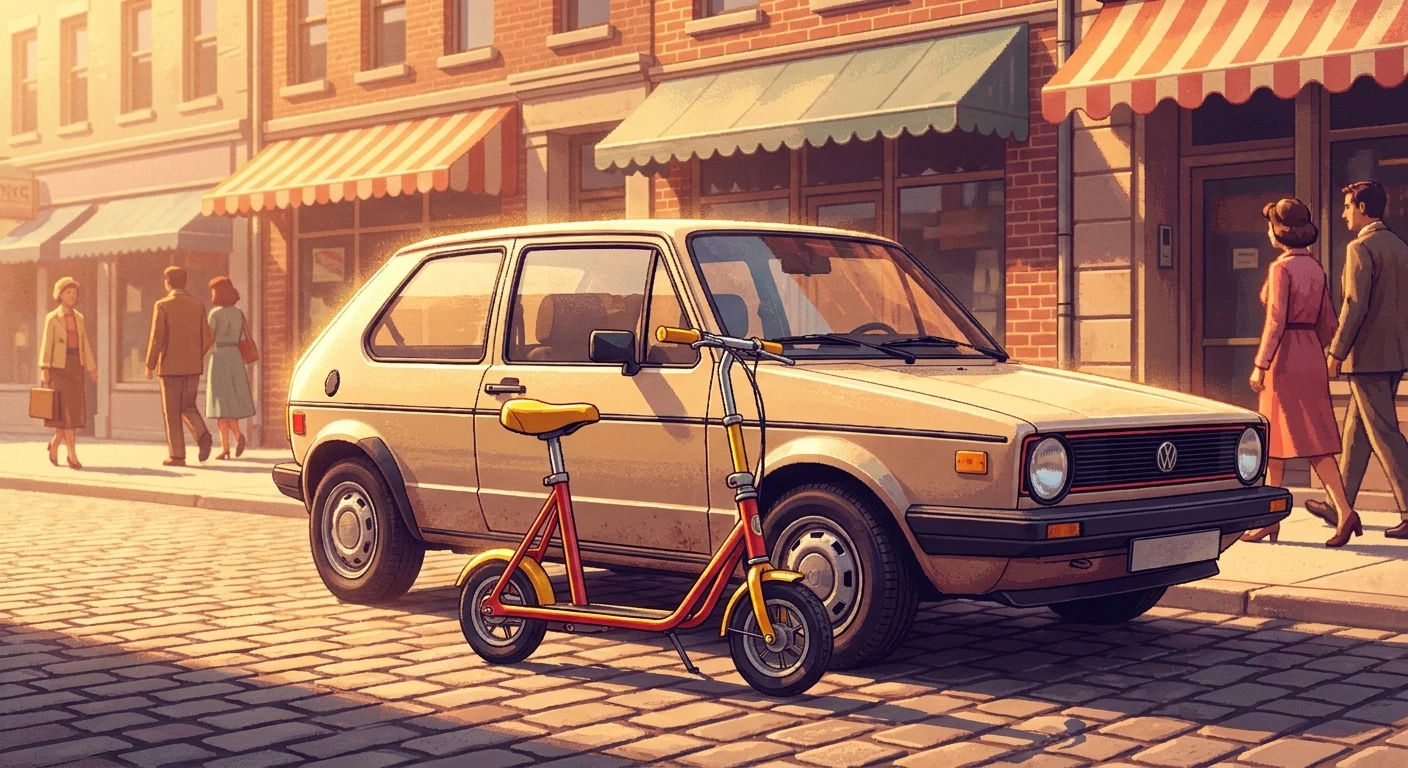
The Legacy of the Honda Motocompo
The Honda Motocompo stands out as one of the most brilliant and highly unusual examples of automotive engineering from the 1980s. Designed as a compact, folding scooter, this incredible micro-machine was engineered to solve the problem of last-mile urban commuting in highly congested metropolitan areas. If you look back at the era of its creation, Japanese automakers were experimenting wildly with modular transportation concepts, and this folding bike was their crowning achievement. The core philosophy was brilliantly simple: you drive your subcompact car to the outskirts of a crowded city center, park where space is plentiful, and then retrieve your portable scooter from the trunk to navigate the narrow alleys and heavy traffic to your final destination. Today, this visionary approach to mobility has made the vintage scooter a highly sought-after collector’s item worldwide. Enthusiasts spend years hunting down restorable models, drawn to its unique boxy aesthetic and sheer mechanical ingenuity. Let me tell you, there is absolutely nothing on the modern market that replicates the specific charm and utilitarian magic of this retro trunk bike.
Understanding the Utility and Value Proposition
To truly appreciate this vintage machine, you have to look closely at its practical benefits, both in its historical context and its modern standing as a premium collectible. The genius of the design lies entirely in its rectangular dimensions. When the handlebars and seat are folded away, the scooter essentially becomes a smooth, compact box. This prevented snagging on the vehicle interior when loading or unloading. Let us break down the core value proposition with a few prime examples. First, the aesthetic integration: the bike was originally marketed alongside the Honda City subcompact car, designed specifically to slot seamlessly into its rear cargo area. Second, the urban agility: navigating dense Tokyo streets in 1981 required a nimble machine, and a dry weight of just 42 kilograms meant a rider could maneuver through practically any gridlock.
Read also: BC Global Contests: The Ultimate Winning Strategy; Navigating Montreal Traffic: The Ultimate Commuter Guide.
| Specification Category | Detailed Metric | Engineering Impact |
|---|---|---|
| Dimensions (Folded) | 1185 mm x 240 mm x 540 mm | Allowed for perfect horizontal storage inside standard subcompact vehicle trunks. |
| Powertrain System | 49cc Air-cooled 2-stroke | Provided sufficient low-end torque for city commuting while keeping total weight strictly minimized. |
| Fuel and Oil System | Anti-leak valves and sealed caps | Ensured zero hazardous spills when the scooter was tipped over and stored sideways. |
| Chassis and Frame | Pressed steel monocoque | Delivered structural rigidity despite the hollowed-out sections required for folding components. |
For modern classic vehicle enthusiasts, owning one offers distinct benefits that go far beyond mere transportation. Here are the top three reasons collectors actively pursue this specific model:
- Unmatched Historical Significance: It represents a unique, bold era of Japanese economic boom engineering where completely out-of-the-box concepts received massive corporate funding and full production greenlights.
- Astounding Pop Culture Pedigree: Thanks to its prominent feature in classic 1980s and 1990s anime, most notably ‘You’re Under Arrest’, the scooter holds an iconic status among global pop culture fans and retro-futurism enthusiasts.
- High Return on Investment: Unlike standard mopeds from the same decade that have depreciated to near worthlessness, intact original models have seen a massive surge in auction value, making them a legitimate alternative investment vehicle.
The Origins and the Honda City Connection
The story begins in the late 1970s when Japanese engineers were tasked with creating the ultimate urban commuting ecosystem. They did not just want to build a small car; they wanted to build a comprehensive mobility system. Thus, the idea of the ‘Trunk Bike’ was born. When the Honda City hatchback launched in November 1981, it was heavily marketed with this tiny companion vehicle as a bespoke accessory. The television advertising campaign was famously fronted by the British ska band Madness, who bounded across the screen with upbeat, chaotic energy, perfectly matching the quirky nature of the new products. The scooter was available in three distinct, vibrant colors: Shetland White, Daisy Yellow, and Caribbean Red. These bright tones were deliberately chosen to contrast or compliment the bold exterior options of the City hatchback, creating a unified lifestyle package for young, trendy urbanites.
Evolution of the Folding Scooter Concept
While the initial launch generated massive media buzz and immense public interest, the actual sales figures did not match the ambitious corporate projections. The original corporate target was to sell 10,000 units per month. In reality, during its short production run from late 1981 to 1983, a total of approximately 53,369 units were manufactured. The main issue at the time was the retail price and the physical reality of lifting a 42-kilogram machine into a car trunk, which proved slightly too heavy for the average commuter to do on a daily basis without strain. However, despite the production coming to a halt after just two years, the fundamental concept never truly died. The evolution of the idea paved the way for modern electric kick scooters and folding e-bikes that dominate cities today. The original engineers were simply 40 years too early for battery technology to catch up with their vision.
Modern State and Collector Market
Today, the landscape for this micro-scooter has shifted entirely from practical daily utility to high-end vintage collection. You will rarely see one navigating a morning commute; instead, they are the stars of classic car shows, often displayed proudly next to imported JDM (Japanese Domestic Market) vehicles. Sourcing a complete, running model requires scouring specialized import brokers, auction sites like Yahoo Auctions Japan, or boutique classic motorcycle dealers. Prices have skyrocketed. A pristine, unrestored model complete with original manuals and the factory cover can fetch extraordinary sums at international auction houses. The current community is incredibly tight-knit, relying on 3D printing and custom fabrication to recreate rare plastic shrouds and rubber seals that the original manufacturer discontinued decades ago.
Powertrain Dynamics and Engineering
Looking under the square plastic fairings reveals an absolute marvel of compact packaging. The propulsion comes from the AB12E engine block, a 49cc air-cooled, two-stroke single-cylinder engine. It produces precisely 2.5 horsepower at 5,000 RPM, with a peak torque of 0.38 kg-m at 4,500 RPM. This does not sound like a lot of power, but considering the tiny 8-inch wheels and the minimal mass of the chassis, it was perfectly geared for rapid acceleration between city traffic lights. Power is delivered to the rear wheel through an automatic single-speed clutch, eliminating the need for a foot shifter or hand clutch, which made the scooter exceptionally accessible to drivers who had never ridden a traditional motorcycle before. The exhaust system is seamlessly routed entirely within the bodywork to prevent any hot surfaces from burning the rider’s legs or damaging the trunk interior.
Structural Integrity and Folding Mechanics
The true genius of the engineering lies in the folding mechanism. To achieve the perfect rectangular shape, every protruding control surface had to be retractable. The process involves unlocking the handlebars via large rotary knobs, folding them down flush into the top recess of the body, and dropping the padded seat down into the frame. Furthermore, storing a gas-powered vehicle on its side inside an enclosed car required specialized safety features. The engineers integrated a complex system of breather valves and fuel petcocks that had to be manually shut off, creating a vacuum seal that prevented a single drop of gasoline or two-stroke oil from leaking out.
- Engine Type: Air-cooled, 2-stroke, single cylinder (AB12E).
- Displacement: 49 cubic centimeters.
- Maximum Output: 2.5 PS at 5,000 RPM.
- Fuel Capacity: 2.2 Liters (including reserve).
- Starting Mechanism: Manual kick-starter only.
- Tire Dimensions: 2.50-8 4PR for both front and rear.
- Braking System: Mechanical leading-trailing drum brakes.
Day 1: Assessing the Frame and Rust
Restoring a classic folding scooter requires a methodical, step-by-step approach. Your first priority should be stripping away the plastic body panels to assess the steel monocoque frame underneath. These vehicles are now over forty years old, and if they were stored outside or in damp sheds, rust will be your primary enemy. Carefully inspect the bottom floorboards and the structural mounting points for the engine block. Sandblasting and applying a high-quality rust converter is an absolute necessity before any structural welding begins. Do not rush this foundational step.
Day 2: Securing Replacement Plastics
The iconic rectangular shape is heavily dependent on the external ABS plastic shrouds. Due to decades of UV exposure, original panels are often extremely brittle and prone to cracking. Sourcing OEM (Original Equipment Manufacturer) replacements is nearly impossible today. You must meticulously repair existing cracks using ABS plastic welding techniques or specialized two-part epoxy resins. For missing panels, networking within vintage scooter communities to find aftermarket fiberglass replicas or high-end 3D-printed alternatives will save your project.
Day 3: Rebuilding the 49cc Two-Stroke Engine
Two-stroke engines are mechanically simple, but they demand perfect compression and pristine seals. You will need to pull the engine from the frame, split the crankcases, and replace all the primary bearings and crank seals. Old rubber hardens over time, and a leaking crank seal will cause severe air leaks, resulting in a dangerously lean running condition. Install fresh piston rings, hone the tiny cylinder wall, and ensure the exhaust port is completely free of built-up carbon deposits.
Day 4: Fixing the Folding Mechanism
The mechanical latches that secure the handlebars and seat are the most critical safety components. If the handlebar locks fail while riding, the results could be disastrous. Disassemble the rotary knobs, clean the threaded rods with a wire wheel, and heavily lubricate them with lithium grease. Inspect the internal springs that pop the seat up; if they have lost their tension, match their dimensions and replace them with industrial-grade stainless steel equivalents.
Day 5: Addressing Fuel System Leaks
Given that this scooter is designed to be transported horizontally, the fuel system must be absolutely impregnable. Rebuild the carburetor with modern ethanol-resistant rubber gaskets. The original petcock seals are notorious for drying out and failing. You must replace every single fuel line, the inline filter, and thoroughly test the anti-spill breather valve on the gas cap by filling the tank with a safe solvent and laying it on its side for a few hours to ensure perfect retention.
Day 6: Sourcing Original Decals and Paint
To retain maximum collector value, your restoration should strictly adhere to the original factory specifications. That means utilizing modern two-stage urethane paints matched perfectly to Caribbean Red, Daisy Yellow, or Shetland White. Furthermore, the warning labels and branding decals placed around the controls and bodywork are essential. Thankfully, specialized graphic reproduction companies offer complete vinyl decal kits that perfectly replicate the original typography and colors, ensuring a showroom-fresh aesthetic.
Day 7: Tuning for Modern Fuels
The gasoline available in 1981 was vastly different from modern ethanol-blended fuels. The tiny Mikuni carburetor will likely require slight rejetting to run smoothly on contemporary premium unleaded fuel. Additionally, use the absolute highest quality modern synthetic 2-stroke oil for the injection system to minimize smoke and maximize engine longevity. Once tuned, you can enjoy crisp throttle response and the distinctive, buzzy exhaust note that defines this historic micro-machine.
Myths and Reality
Myth: The scooter was a massive commercial success that dominated global markets in the 1980s.
Reality: Despite immense historical relevance today, it actually missed its original sales targets by a wide margin. It was heavily marketed in Japan, but the physical weight and niche use case limited mass-market adoption, leading to a very short production lifespan.
Myth: It is completely illegal to ride on modern roads due to safety regulations.
Reality: In most jurisdictions, it can be fully registered and legally ridden as a standard 50cc moped. As long as it retains its functioning turn signals, brake lights, and horn, it is street legal, though its low top speed makes it unsuitable for busy arterial highways.
Myth: You can still buy new parts directly from original manufacturer dealerships.
Reality: Almost all proprietary parts were discontinued decades ago. Owners must rely heavily on the secondary market, custom fabrication, part cross-referencing with other classic mopeds, and dedicated community forums for spares.
Frequently Asked Questions
How fast can it actually go?
Under optimal conditions, on a flat surface with an average-weight rider, the absolute top speed is approximately 30 km/h (about 18 mph). It was specifically geared for quick low-speed acceleration rather than high top speeds.
How much does it weigh?
The dry weight is approximately 42 kilograms (93 pounds), and when fully loaded with gasoline and two-stroke oil, it hits roughly 45 kilograms (99 pounds). Lifting it requires a bit of strength.
Did it only come bundled with a car?
No, while it was heavily promoted as a lifestyle accessory for the Honda City hatchback, it was entirely available for purchase as a standalone vehicle at motorcycle dealerships across Japan.
What is one worth in today’s market?
Values fluctuate wildly based on condition. A non-running project bike might sell for $2,000, while a perfectly restored, museum-quality example complete with all original accessories can easily exceed $8,000 to $10,000 at auction.
Can I fit it in a modern car trunk?
Yes. Because of its extremely compact folded dimensions (1185 mm in length and just 540 mm in height), it will comfortably fit into the rear of almost any modern hatchback, crossover, or mid-sized sedan.
What type of fuel does it require?
It utilizes standard unleaded gasoline. However, because it is a two-stroke engine, it relies on a separate oil tank that automatically mixes two-stroke oil with the gasoline to lubricate the internal engine components.
Does it have a manual gearbox?
No. It uses an automatic single-speed transmission with a centrifugal clutch. The rider only needs to twist the throttle grip to accelerate and squeeze the hand levers to brake, making it exceptionally easy to operate.
To conclude, the Honda Motocompo is far more than just an obscure vintage novelty. It is a striking artifact of bold engineering and cultural optimism, reflecting a time when solving urban mobility problems resulted in truly unique mechanical art. Whether you are actively looking to restore one or just fascinated by the history of automotive design, there is no denying its legendary status. Keep hunting for those rare parts, stay active in the classic scooter community, and always celebrate the incredible legacy of the ultimate trunk bike!






