
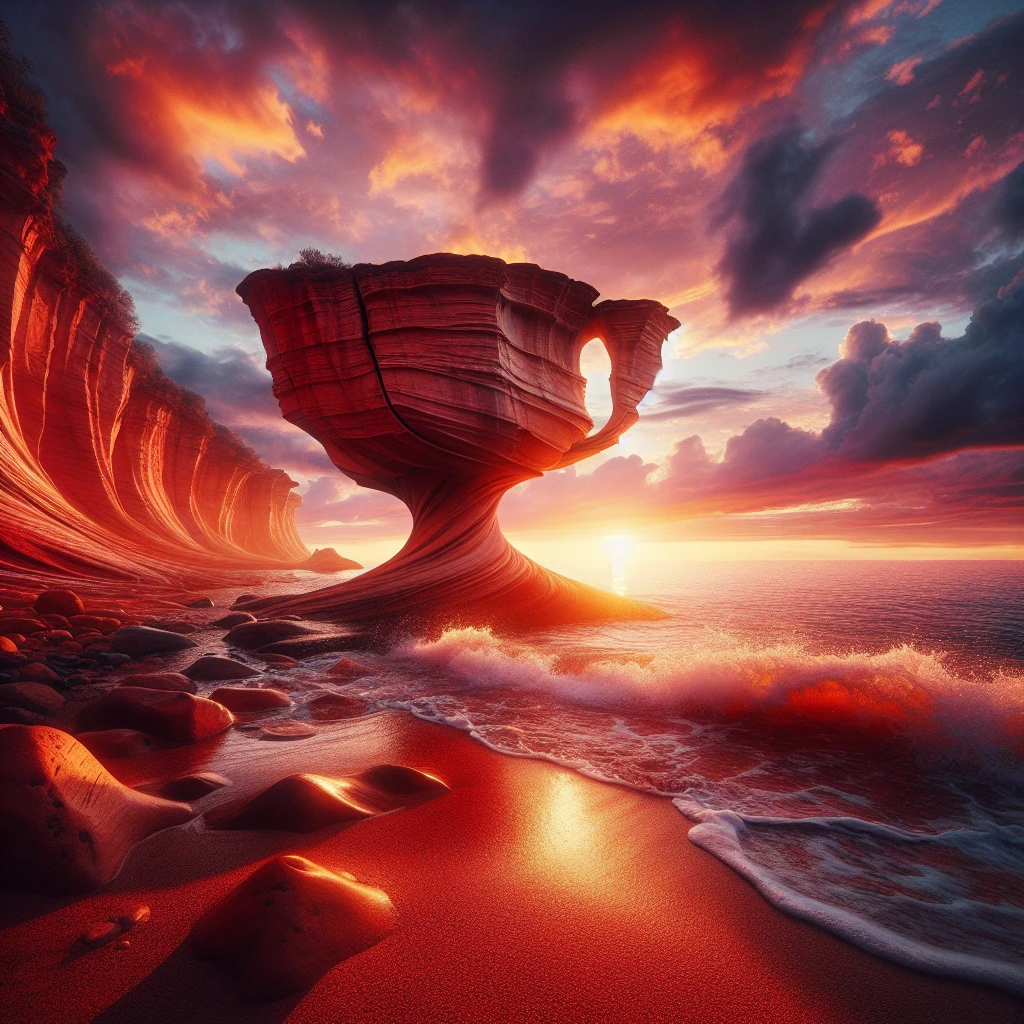
Teacup Rock PEI: A Legendary Landmark We Will Never Forget
Did you ever get the chance to stand beneath the massive sandstone arches of teacup rock pei before the ocean finally took it away? If you did, you know exactly how magical that stretch of coastline felt. Now, here we are in 2026, and the complete absence of this iconic Prince Edward Island formation still feels entirely surreal. You walk down the sandy stretch of Thunder Cove Beach, listen to the crashing waves, and instinctively look for that familiar silhouette against the sunset—only to remember it belongs to the sea now. The landscape has changed forever.
I vividly remember my own trip down to that specific beach back in 2021. The deep red sand was clinging heavily to my boots, the salty wind was whipping aggressively across the Gulf of St. Lawrence, and there it was—a massive, top-heavy boulder balancing on a shockingly thin base. It literally looked like a teacup placed delicately on a saucer by some ancient giant. Locals hanging around the beach would always warn visitors to take their photos quickly because you never knew when the ocean would reclaim it. They were absolutely right. The reality of nature’s relentless power is something we all have to respect, especially on an island made almost entirely of remarkably soft red sandstone.
Understanding what happened to this famous formation gives us a newfound appreciation for the raw power of nature. We are going to examine the fascinating history of this coastal wonder, the science behind its eventual collapse, and exactly how you can still experience the magic of the island’s dynamic shores right now.
The Core Reality of Our Shifting Coastlines
When we talk about the core reality of teacup rock pei, we have to look closely at the delicate balance between modern tourism, natural beauty, and harsh environmental realities. For decades, this specific sea stack was a crown jewel for professional photographers, casual travelers, and nature lovers alike. But its very existence was always a double-edged sword: the exact forces of water and wind that carved it into such a magnificent shape were the exact same forces guaranteed to eventually destroy it.
Understanding the full lifecycle of such coastal landmarks gives us profound respect for our immediate environment. Here is a quick breakdown of how the Thunder Cove area has transitioned over the past few years:
| Era | Physical State of the Landmark | Cultural Impact on Tourism |
|---|---|---|
| Pre-2022 | Intact, balancing precariously on a remarkably thin sandstone stem. | Massive influx of social media tourists; viewed as the definitive symbol of Thunder Cove. |
| Hurricane Fiona (Late 2022) | Completely obliterated by historic storm surges and extreme wind velocity. | Global news coverage; widespread mourning among island locals and frequent visitors. |
| Present Day (2026) | Reclaimed entirely by the ocean; only scattered, unidentifiable base stones remain visible. | Educational tourism has surged; people visit specifically to witness the terrifying power of nature. |
The value of actively remembering this landmark goes far beyond basic nostalgia. First, it serves as an unparalleled visual lesson in extreme coastal geology. When you look at photos of the rock from twenty years ago compared to right before it fell, the sheer volume of rock lost is staggering. Second, it has completely shifted the entire tourism mindset on PEI. Instead of chasing permanent stone monuments, visitors now arrive to appreciate the fleeting, ever-changing nature of the beautiful coastline.
If you are actively planning a trip to the coast soon, keep these three essential perspectives firmly in mind:
- Understand the extreme fragility of sandstone structures. Never climb on them, lean against them heavily, or chip away at them, as your weight and actions drastically accelerate their inevitable destruction.
- Appreciate the temporary art of nature. Take your amazing photos, make your wonderful memories, but know absolutely that the landscape will look completely different the very next time you visit the island.
- Respect the broader climate shifts occurring around us. As storm intensities steadily increase across the globe, these rapid geological changes will only become much more common and severe.
The Deep History and Origins of the Red Stone
Origins of the Permian Red Beds
To truly appreciate the teacup rock pei phenomenon, you have to go back way further than the invention of the camera. You have to go back roughly 300 million years to the Permian period. During this ancient era, the landmass that would eventually become Prince Edward Island was located near the equator. Massive ancient rivers deposited enormous amounts of sand, silt, and gravel into a massive basin. Over millions of years, the iron oxide in the soil essentially rusted, giving the sandstone its famous, striking red hue. This rock is notoriously soft, meaning it is exceptionally vulnerable to the elements.
The Evolution of Thunder Cove Beach
Fast forward a few million years, and glacial movements carved out the modern Gulf of St. Lawrence. As the glaciers retreated, the soft red sandstone was completely exposed to the violent waves of the ocean. Thunder Cove Beach became a prime location for accelerated erosion. The ocean waves relentlessly pounded the coastal cliffs, exploiting tiny cracks and weaknesses in the stone. Eventually, sections of the cliff collapsed, leaving behind isolated columns of rock known as sea stacks. The teacup was born from one of these massive cliff collapses, slowly whittled down over centuries into its distinct, narrow-based shape.
The Modern State: A Post-Fiona World in 2026
By the time social media made the rock globally famous in the 2010s, it was already on borrowed time. Geologists repeatedly warned that the base was getting dangerously thin. Then came Hurricane Fiona in September 2022. The historic storm battered the island with unprecedented ferocity. When the sun finally rose after the storm, the famous rock was simply gone. Now, in 2026, Thunder Cove Beach has found a new identity. It is a place of profound reflection. The cliffs continue to erode, new sea caves are actively forming, and smaller, baby sea stacks are beginning their own long journey of shaping and eventual destruction.
The Complex Science of Coastal Erosion
The Mechanics of Rock Deterioration
Why did it fall so easily? The answer lies in the specific geological mechanics of coastal erosion. The primary culprit is a process called hydraulic action. When massive ocean waves crash against a stone surface, they force air deep into the microscopic cracks of the rock. As the wave forcefully retreats, the compressed air expands violently in a miniature explosion, weakening the structural integrity of the stone. Over time, this literally blasts the rock apart from the inside out.
Hurricane Fiona’s Geological Impact
While the rock was already weakening, it required a massive catalyst to finally bring it down. Hurricane Fiona provided that fatal blow. The storm was a terrifying showcase of meteorological power. The combination of sustained wind, low atmospheric pressure, and massive water displacement created the perfect storm for extreme coastal destruction. To understand just how severe this event was, look at the brutal scientific realities of that night:
- Storm Surge Levels: Water levels rose over 2.5 meters above normal high tide, allowing the heavy ocean waves to strike the delicate upper portion of the teacup formation directly.
- Peak Wind Gusts: Winds were recorded exceeding 150 kilometers per hour, creating immense lateral pressure on the already top-heavy sandstone structure.
- Wave Amplitude: Offshore buoys recorded monstrous waves reaching over 10 meters in height, carrying millions of pounds of kinetic energy directly into the shoreline.
- Accelerated Abrasion: The storm waves were heavily choked with loose sand and rocky debris, acting like giant belts of industrial sandpaper grinding against the teacup’s vulnerable stem.
The Ultimate 2026 PEI Coastal Geology Tour
Just because the famous landmark is gone doesn’t mean your trip to the island is ruined. In fact, exploring the coastline in 2026 offers a much richer, more educational experience. Here is a robust, highly active 7-Day plan to experience the absolute best of PEI’s shifting geology.
Day 1: Arrival at Thunder Cove Beach
Begin your journey where it all happened. Arrive at Thunder Cove Beach in the late afternoon. Walk the extensive sandy shoreline and look at the newly exposed cliff faces. You can clearly see fresh rock falls and the sheer, bright red scars where the earth has recently given way. Take time to photograph the remaining, smaller sea stacks that are slowly taking the place of the old giant.
Day 2: Exploring Darnley and the Surrounding Cliffs
Head slightly up the coast to the Darnley region. This area features incredible, towering red cliffs that offer a stunning panoramic view of the Gulf. Spend the day hiking the established coastal trails. You will notice how the local vegetation aggressively clings to the edges of the crumbling cliffs, creating a beautiful contrast of bright green against deep red.
Day 3: The Cavendish Dunelands Walk
Shift your focus from rigid rock to shifting sand. The Cavendish dunes are a spectacular example of wind erosion and deposition. Walk the extensive boardwalks to protect the fragile marram grass. This grass is the only thing holding these massive sand structures together. It is a brilliant display of nature’s delicate engineering.
Day 4: Greenwich National Park and Parabolic Dunes
Drive over to Greenwich to witness the massive parabolic dune system. These giant, crescent-shaped dunes are incredibly rare. The floating boardwalk over the surrounding marshland is an absolute masterpiece of trail design. You will learn extensively about how the wind continuously reshapes the entire geography of the northern island coast.
Day 5: Red Sands Shore and Victoria-by-the-Sea
Travel to the southern shore of the island. The water here is generally much calmer, but the tidal flats stretch out for literal miles during low tide. Walk out onto the exposed ocean floor and search for hermit crabs, starfish, and unique clam beds. The geology here is much flatter, showing a completely different side of the island’s sedimentary history.
Day 6: East Point Lighthouse and Wind Dynamics
Drive out to the absolute eastern tip of the island where the tides of the Northumberland Strait fiercely meet the Gulf of St. Lawrence. The converging waters create spectacular, chaotic waves. The East Point Lighthouse stands as a historic sentinel over this dangerous water. You can visually track how the extreme wind dynamics have shaped the surrounding coastline over hundreds of years.
Day 7: Reflecting at the Confederation Bridge
End your week-long tour near the massive Confederation Bridge. As you look at this incredible feat of modern human engineering spanning the ocean, contrast it with the natural, crumbling red cliffs nearby. It perfectly encapsulates the enduring struggle between human construction and the unstoppable forces of natural coastal erosion.
Debunking Common Coastal Myths
Whenever a famous landmark disappears, wild stories quickly emerge. Let’s clear up some massive misconceptions circulating in 2026.
Myth: The rock was maliciously destroyed by thoughtless vandals.
Reality: While human interaction definitely caused minor wear over the years, it was strictly the brutal force of Hurricane Fiona in September 2022 that completely obliterated the rock in a single night.
Myth: There are absolutely no cool rock formations left on PEI anymore.
Reality: The exact opposite is true. The same brutal erosion that destroyed the teacup is constantly carving entirely new sea caves, brilliant arches, and magnificent rock columns all along the northern shoreline.
Myth: The landmark was a permanent, ancient fixture that lasted for many thousands of years.
Reality: In geological terms, sea stacks are incredibly short-lived. The specific teacup shape only existed in its highly recognizable, ultra-thin form for a few short decades before its inevitable collapse.
Myth: It is entirely unsafe to visit any PEI beaches post-Fiona.
Reality: The beaches are perfectly safe and entirely open to the public in 2026, provided you apply basic common sense, stay safely away from the absolute edges of the cliff overhangs, and respect the posted local warning signs.
Frequently Asked Questions About the Shoreline
Is teacup rock pei still there?
No, the famous rock formation is completely gone. It was totally destroyed by the massive storm surges of Hurricane Fiona in late 2022. Only small, unrecognizable fragments remain at the bottom of the ocean.
Where was the teacup rock located?
It was proudly located at Thunder Cove Beach on the northern coast of Prince Edward Island, near the lovely community of Darnley.
What caused the total destruction of teacup rock?
The total destruction was caused by a devastating combination of intense coastal erosion over many years, topped off by the massive, violent waves and historic winds of Hurricane Fiona.
Can I still visit Thunder Cove Beach in 2026?
Absolutely. The beach remains open and continues to be one of the most stunning, picturesque coastal areas on the entire island, offering breathtaking sunsets and fascinating new rock formations.
Are there other sea stacks on Prince Edward Island?
Yes, numerous other sea stacks actively exist along the northern shore. Because the red sandstone is so soft, new stacks are continually forming as the main cliffs slowly fall away into the sea.
How fast is PEI actually eroding?
On average, the coastlines of Prince Edward Island lose roughly 30 centimeters of land every single year. However, massive storm events can wipe out several meters of cliff face in just a few terrifying hours.
Why is the sand so red on PEI?
The stunning red color comes from a tremendously high concentration of iron oxide (essentially natural rust) heavily embedded directly within the ancient sandstone that makes up the island’s bedrock.
While the loss of this beautiful natural monument was deeply felt by millions around the world, it serves as a brilliant reminder to appreciate the natural world while we have it. The geography of Prince Edward Island is a living, breathing entity that constantly shifts, breaks, and beautifully reforms. Do not wait for things to last forever. Book your travel plans for 2026, pack your camera, head out to the incredible red sandy shores, and witness the raw, magnificent power of the ocean for yourself!