
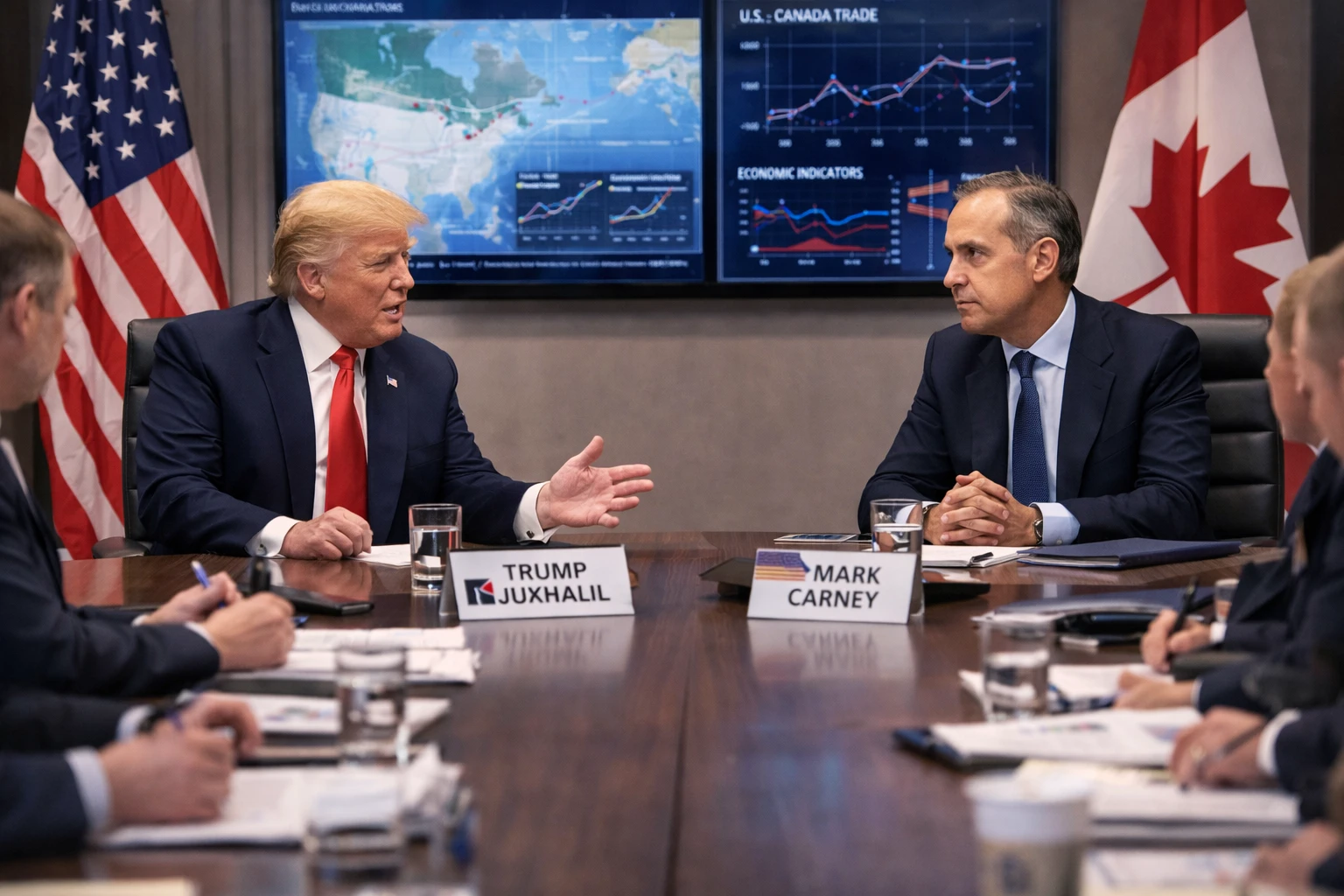
The Northern Neighbor and the New Dialogue: Why the Trump-Carney Talk Matters
So, we’ve all been watching the headlines lately, and if you live anywhere between Victoria and St. John’s, you know that when Washington sneezes, Ottawa usually catches a cold. But lately, things feel a bit different. There’s a new energy in the room, specifically surrounding the recent interactions between Donald Trump and Mark Carney. Now, if you follow the money or the news, those are two names you wouldn’t necessarily expect to see in the same sentence without a whole lot of friction. But here we are, in 2026, looking at a landscape where pragmatism might just be trumping-pun intended-the old ways of doing business.
Let’s be real for a second. Canada and the U.S. aren’t just neighbors; we’re like those two roommates who share a bank account and a fridge. We need each other. But when the leadership styles are polar opposites, people start getting nervous about their mortgage rates and the price of milk. Carney, with his “Bank of England/Bank of Canada” polish, and Trump, with his “Art of the Deal” flair, represent two very different worlds. Yet, their dialogue is sparking a conversation about how Canada can navigate a more protectionist U.S. without losing its shirt. Honestly, it’s about time someone started talking straight about the math instead of just the talking points.
You might be wondering, why Carney? Well, the guy has been everywhere. He’s the “adult in the room” for a lot of folks who worry about economic stability. When he engages with the U.S. administration, it’s not just polite tea-time chat. It’s about the CUSMA (or USMCA, depending on which side of the border you’re on) and ensuring that Canadian steel, aluminum, and even our tech sector don’t get sidelined by “America First” policies. It’s a delicate dance, and frankly, it’s one that affects your wallet more than you might think.
Trade Wars and Table Manners: The Economic Stakes
When we talk about international relations, it often sounds like something happening in a far-off boardroom. But for us in Canada, it’s about the supply chain. Have you tried buying a car or renovating a kitchen lately? The prices are tied directly to these cross-border vibes. The Trump-Carney dialogue seems to be focusing on a “cooperative competition.” It’s a bit of a weird term, right? But it basically means: we’re going to compete, but let’s not burn the house down while we do it.
The U.S. is pushing hard on energy independence and bringing manufacturing back home. For Canada, this is a bit of a double-edged sword. On one hand, we have the resources they need-especially the critical minerals for those EVs everyone is talking about. On the other hand, if the U.S. puts up too many walls, our exporters are in trouble. Carney’s role in this dialogue seems to be reminding the American side that a prosperous Canada is actually their best customer. It’s a simple point, but sometimes the simplest points get lost in the noise of a campaign or a rally.
Take a look at how our trade balance actually looks right now. It’s not just about oil and gas anymore. It’s about software, film production, and high-tech agriculture. If the dialogue stays constructive, we might see some exemptions for Canadian goods that keep our local industries humming. If it goes south? Well, we’ve seen that movie before, and it usually involves a lot of “buy American” rhetoric that makes our exporters break out in a cold sweat.
Here is a quick breakdown of what is currently on the line during these discussions:
| Sector | What Canada Wants | The U.S. Stance |
|---|---|---|
| Automotive | Integrated supply chains | More US-based parts |
| Energy | Pipeline security & exports | Domestic production first |
| Tech/AI | Talent mobility | Data sovereignty |
| Agriculture | Dairy market protection | More access for US farmers |
Why the “Carney Factor” Changes the Game
Mark Carney isn’t your typical politician. In fact, some would say he isn’t a politician at all, though his name keeps popping up in every Liberal leadership rumor mill. He’s a technocrat with a resume that makes most economists look like they’re playing with Lego. His ability to speak “Wall Street” and “Main Street” at the same time is a rare skill. In his talks with the Trump camp, he’s not coming from a place of ideological protest. He’s coming with spreadsheets. And in the current U.S. climate, numbers often speak louder than “shared values” speeches.
Think about it. Trump respects success and big players. Carney, having run two central banks, fits that mold. This dialogue allows Canada to have a voice that isn’t just “we’re nice neighbors, please like us.” Instead, it’s “here’s why it’s in your financial interest not to tax our lumber into oblivion.” It’s a shift from diplomacy to a sort of high-stakes consulting. Does it work? Well, it’s better than being ignored, which is the real danger for a middle power like Canada.
But it’s not all sunshine and rainbows. There’s a lot of skepticism back home. Some folks think Carney is too “globalist” for a world that is turning inward. Others worry that any deal made with a Trump administration is written in disappearing ink. The reality is probably somewhere in the middle. We need a bridge-builder, and Carney is currently the only one with the hard-hat and the blueprints ready to go. Whether he can actually finish the bridge before the next political storm hits is the million-dollar question.
Some of the key themes being pushed by the Canadian side include:
- Reliability of the Arctic shipping routes and joint defense.
- Carbon border adjustments and how to keep trade “green” without killing jobs.
- Harmonizing regulations for emerging tech like AI and fintech.
The Border, The Burritos, and the Bottom Line
Let’s talk about the border for a second. It’s not just about tourism. It’s about the thousands of trucks that cross every single day. If the Trump-Carney dialogue leads to a more streamlined “trusted trader” program, that’s a massive win for Canadian businesses. We often forget that a 2-hour delay at the border in Windsor or Sarnia adds millions of dollars in costs to the goods we buy at Loblaws or Canadian Tire. Efficiency is the name of the game, and Carney knows that better than anyone.
There’s also the cultural aspect. Canadians have a love-hate relationship with American politics. We watch their news more than our own sometimes. When the dialogue between our leaders-or our “shadow” leaders like Carney-gets heated, it affects the national mood here. A stable relationship means a stable Loonie. And a stable Loonie means your trip to Florida or Arizona doesn’t cost twice as much as it did last year. It’s the small things that matter to most of us, even when the topics are as big as “International Relations.”
Honestly, it’s kind of refreshing to see a focus on economic pragmatism. For a long time, the Canada-U.S. relationship felt like it was stuck in a loop of polite disagreements. Now, it feels like a high-stakes negotiation where everything is on the table. Is it stressful? Sure. But it’s also an opportunity for Canada to redefine what it brings to the partnership beyond just being the “friendly guy upstairs.”
Energy Independence vs. Climate Goals: The Big Friction Point
Here’s where things get tricky. The Trump administration is all about “drill, baby, drill.” Canada, or at least the current vibe in Ottawa, is heavily focused on the energy transition. Carney himself is a huge advocate for green finance. You’d think they’d be at each other’s throats, right? But the dialogue suggests a middle ground: “Energy Security.” This is a phrase that makes everyone happy. For the U.S., it means not relying on overseas oil. For Canada, it means our oil and gas have a guaranteed market, even while we work on hydrogen and nuclear tech.
Carney’s “Net Zero” ambitions and Trump’s “Energy Dominance” goals might seem like they’re on different planets, but they meet at the gas pump. If Canada can position itself as the “secure, ethical energy provider” for the North American bloc, we stay relevant. If we just preach about the environment without acknowledging the demand for cheap power, we get left behind. It’s a tough tightrope to walk, but the Carney-Trump talks are at least putting the safety net in place.
Imagine a scenario where the U.S. and Canada create a “North American Energy Shield.” This would protect us from global price shocks and ensure that we’re the ones making the rules, not OPEC. It’s a big-picture move that requires a lot of trust-something that’s been in short supply lately. But hey, if anyone can find a way to make the math work for both a climate activist and a real estate mogul, it’s probably a guy who used to run the world’s most powerful central banks.
Check out how our energy exports have shifted over the last couple of years:
| Energy Source | Export Trend (2024-2026) | Primary Market |
|---|---|---|
| Natural Gas | Steady Increase | US Midwest |
| Electricity (Hydro) | Rapid Growth | New York / New England |
| Crude Oil | Slight Increase | US Gulf Coast |
| Uranium | Major Spike | Global / US Nuclear Plants |
The “America First” Impact on Canadian Talent
One thing that doesn’t get enough attention in these diplomatic circles is the “brain drain.” Or, lately, the “brain gain.” When the U.S. tightens its borders or changes its visa rules, Canada often benefits. We’ve seen a lot of tech talent choosing Toronto, Vancouver, or Montreal over Silicon Valley. In the Trump-Carney dialogue, there’s a subtle dance about labor. Canada wants to ensure our professionals can still work across the border, but we also want to keep the talent we’ve worked so hard to attract.
Carney has often spoken about the “economy of the future.” To him, that’s all about people and data. If the U.S. moves toward a more restrictive immigration policy, Canada has a chance to be the North American hub for global talent. But we have to be careful. We don’t want to be seen as a “backdoor” into the U.S., because that’s a quick way to get the border shut down. The dialogue needs to establish clear rules for how we share-and compete for-the best minds in AI and biotech.
It’s a bit of a weird situation. We’re competing with the U.S. for the same people, yet we need to be on the same page regarding security and vetting. If the talks stay productive, we might see a “North American Talent Zone” where it’s easier for a Canadian engineer to work on a project in Austin, and vice versa, without the soul-crushing paperwork. Wouldn’t that be a nice change of pace?
Here is what we are seeing on the ground in the tech hubs:
- Increased VC investment in Waterloo and Toronto from US firms.
- More “satellite offices” of US giants opening in Calgary to tap into the engineering pool.
- A push for “digital nomad” visas that allow Americans to work remotely from the Canadian Rockies.
Infrastructure and the Long Game
You can’t talk about Canada-U.S. relations without talking about the actual physical stuff that connects us. Bridges, pipelines, railways, and fiber-optic cables. The dialogue between these two camps is increasingly focused on “continental resilience.” Basically, if things get messy globally, we need to make sure our own backyard is solid. This means investing in infrastructure that doesn’t just go North-South, but also strengthens our internal connections.
Carney’s background in finance is key here. He knows how to attract private capital to big public projects. If the Trump administration is looking for “big builds,” Canada can offer partnership on things like high-speed rail or upgraded Great Lakes shipping lanes. It’s about making the entire continent more efficient. And let’s be honest, our infrastructure could use a bit of a facelift. Ever driven through some of those border crossings? It feels like 1975 called and wants its concrete back.
The “long game” here is ensuring that North America remains the most competitive region in the world. With the rise of other economic blocs, we can’t afford to be bickering over small-time tariffs. The Trump-Carney dialogue, at its best, is about recognizing this reality. It’s about moving past the “he said, she said” of daily politics and looking at where we want to be in 2030 or 2040. It’s ambitious, maybe even a bit optimistic, but what’s the alternative? Stagnation? No thanks.
Defense and the Arctic: The New Frontier
Alright, let’s get into something a bit more “spy novel.” The Arctic. As the ice melts, the “High North” is becoming a major geopolitical hotspot. Russia and China are both looking at those shipping routes with a lot of interest. In the past, Canada has been a bit slow on the draw with Arctic defense. But in the dialogue with the U.S., this is becoming a top priority. Trump has always been vocal about allies “paying their fair share” for defense, and Canada is finally stepping up with new icebreakers and NORAD upgrades.
Carney’s role here is interesting because defense costs a lot of money. He’s looking at it through the lens of economic sovereignty. If we don’t control our Northern waters, we don’t control the future of trade in that region. The U.S. wants a strong partner in the North, not a vulnerability. So, the dialogue is shifting from “how much do we have to spend?” to “how can we jointly secure this massive resource?”
It’s not just about subs and planes, though. It’s about the communities that live there. Infrastructure in the North-internet, roads, ports-is both a defense move and an economic one. If the Trump-Carney talks lead to more joint investment in the Arctic, it could be a game-changer for Canada’s territories. It’s about time we stopped treating the North like a frozen museum and started treating it like the vital part of our country that it is.
Is This a Permanent Shift or Just a Moment?
That’s the big question, isn’t it? Is this new era of “deal-making diplomacy” here to stay, or will we go back to the old ways the moment the next election cycle hits? Canadians are used to the pendulum swinging back and forth. But the world feels more volatile now. The old rules of global trade are being rewritten, and the Trump-Carney dialogue is a symptom of that change. We’re moving toward a more transactional world, where “what have you done for me lately?” is the primary question.
Some people hate this. They think it erodes the “special relationship” based on shared history and values. Others love it. They think it’s more honest. If we know what the other side wants, we can actually negotiate. No more guessing games. Carney’s involvement suggests that Canada is ready to play this new game. We’re bringing our best players to the table and we’re not afraid to talk about interests instead of just ideals.
Whatever happens, the next few years are going to be a wild ride for Canada-U.S. relations. We’ve got the CUSMA review coming up, ongoing energy debates, and the ever-present pressure of inflation. Having a direct line between the pragmatic wing of the Canadian establishment and the “America First” crowd in D.C. might be exactly what we need to keep the wheels from falling off. Or, at the very least, it’ll give us something interesting to talk about at the next backyard BBQ.
Anyway, that’s the state of play. It’s complicated, a bit messy, and definitely not boring. Whether you’re a Carney fan, a Trump skeptic, or just someone trying to figure out why their grocery bill is so high, this dialogue matters. It’s the engine room of our economy, and right now, the mechanics are finally talking to each other.
Common Questions About the New Canada-U.S. Vibe
Will my cross-border shopping get more expensive?
Honestly, it depends on the day. If these talks prevent new tariffs, prices should stay steady. But the border is always a bit of a wild card when it comes to duties and the exchange rate.
Is Mark Carney actually going to run for Prime Minister?
That’s the rumor that won’t die! He hasn’t said yes, but he’s definitely acting like someone who wants to have a big say in how the country is run. Stay tuned.
Does “America First” mean “Canada Last”?
Not necessarily. The goal of the current dialogue is to show that “America First” actually works better when Canada is a strong, integrated partner. We’re their biggest customer, after all.
What’s happening with the Keystone XL pipeline? Is it dead forever?
In its original form, yeah, probably. But the conversation has shifted to “Energy Corridors,” which might include pipelines, power lines, and hydrogen routes. The name changes, but the need for energy doesn’t.
Will it be easier to work in the U.S. now?
We’re hoping for more streamlined visas for tech and healthcare workers. Both countries are short on labor, so it makes sense to make moving back and forth easier for pros.
Are we going to see more “Buy American” rules?
There’s always a push for that in D.C., but the Carney-Trump dialogue is specifically aimed at getting “Buy North American” exemptions for Canadian companies. It’s a work in progress.
Does the U.S. really care about the Canadian Arctic?
They care about who else is up there. With Russia and China sniffing around, the U.S. is very interested in making sure Canada has the North under control. It’s a security thing.
Wrapping It All Up
At the end of the day, the Canada-U.S. relationship is too big to fail. We’re tied together by history, geography, and a whole lot of money. The dialogue between figures like Trump and Carney might seem like an odd-couple pairing, but it reflects the world we live in now. It’s a world that values results over rhetoric and deals over dinners. For Canada, the challenge is staying true to our own path while making sure we aren’t left behind by a changing America.
We’ve seen that being “nice” isn’t a trade strategy. We need to be smart, we need to be prepared, and we need to be at the table. Whether this specific dialogue leads to a new “Golden Age” of cooperation or just a series of “least-bad” compromises remains to be seen. But one thing is for sure: we can’t afford to stop talking. The stakes-from the price of the gas in your tank to the security of our Northern borders-are just too high. So, here’s to the pragmatists, the deal-makers, and the messy business of being neighbors. It’s never easy, but it’s always important.